
5 Beauty Loyalty Program Examples: What Brands Can Learn
Compare Sephora, Ulta, e.l.f., LUSH and Glossier loyalty programs. Explore points, tiers, rewards and practical ideas for your beauty brand.
The strongest beauty loyalty programs don’t all reward customers in the same way.
Sephora combines points with exclusive membership tiers. Ulta Beauty makes loyalty points useful as purchase discounts. e.l.f. Cosmetics rewards customers for activities beyond shopping. LUSH connects rewards to product discovery and its wider brand experience. Glossier shows that exclusive access and recognition can encourage loyalty without a traditional points system.
These five beauty loyalty program examples demonstrate different approaches to keeping customers engaged.
For beauty retailers, skincare brands and cosmetics businesses, the interesting question isn’t simply which program is the biggest. It’s which elements are practical to introduce into your own customer experience.
This guide compares the programs using their published rules and explains what smaller beauty businesses can learn from them.
Five beauty loyalty programs at a glance
A beauty loyalty program rewards an ongoing relationship between a customer and a cosmetics retailer or beauty brand. Rewards can include points, discounts, products, exclusive access or membership benefits.
The five examples below illustrate how differently those incentives can work.
| Brand | Earning model | Redemption approach | Standout feature | Best lesson |
|---|---|---|---|---|
| Sephora | 1 point per eligible $1 | Product rewards or qualifying discounts | Rewards Bazaar | Reward variety |
| Ulta Beauty | 1–1.5 points per eligible $1 | Published dollar-off thresholds | Flexible monetary value | Clear redemption |
| e.l.f. Cosmetics | 10 points per eligible $1 | Eligible products, rewards and benefits | Engagement activities | Reward participation |
| LUSH | Points on qualifying spending | Rewards unlocked at thresholds | Product experiences | Brand alignment |
| Glossier | No standard points system | Membership benefits | Early access and gifts | Exclusivity |
Sephora’s standard Beauty Insider Cash option exchanges 500 points for $10 off an eligible purchase, while Ulta publishes a value of $17.50 off for 500 points. That does not make Ulta universally more valuable: earning rates, tier bonuses, product rewards, qualifying conditions and each customer’s shopping behavior differ.
A frequently replenished skincare line may benefit from straightforward purchase rewards. A premium cosmetics brand might prefer limited access or recognition, while a community-focused brand may want to reward participation.
Five beauty loyalty programs worth studying
1. Sephora Beauty Insider: Making loyalty feel like status
Sephora’s Beauty Insider combines practical rewards with membership recognition. Members earn one point per eligible dollar and can use points for changing product rewards and experiences through the Rewards Bazaar. The standard Beauty Insider Cash option also allows 500 points to be exchanged for $10 off a qualifying purchase.
Its Insider, VIB and Rouge tiers recognize different levels of annual spending and provide access to benefits associated with membership status.
Customers can participate without reaching a higher tier, while frequent shoppers gain additional recognition. Product-related rewards also support discovery in a category where customers often want to try skincare, makeup or fragrance before buying a full-size item.
According to Sephora’s current Beauty Insider terms, rewards and benefits are subject to eligibility and availability. A smaller brand can borrow the principle without copying the scale: offer an attainable base reward, then add a genuinely different benefit—such as early access or a sample collection—only when a higher tier earns its complexity.
2. Ulta Beauty Rewards: Making points genuinely valuable
Ulta Beauty takes a direct approach to rewarding customer spending. Members earn one point per eligible dollar, while Platinum and Diamond members earn 1.25 and 1.5 points per dollar respectively.
The program publishes clear redemption values, including $3 off for 100 points, $17.50 off for 500 points and $125 off for 2,000 points.
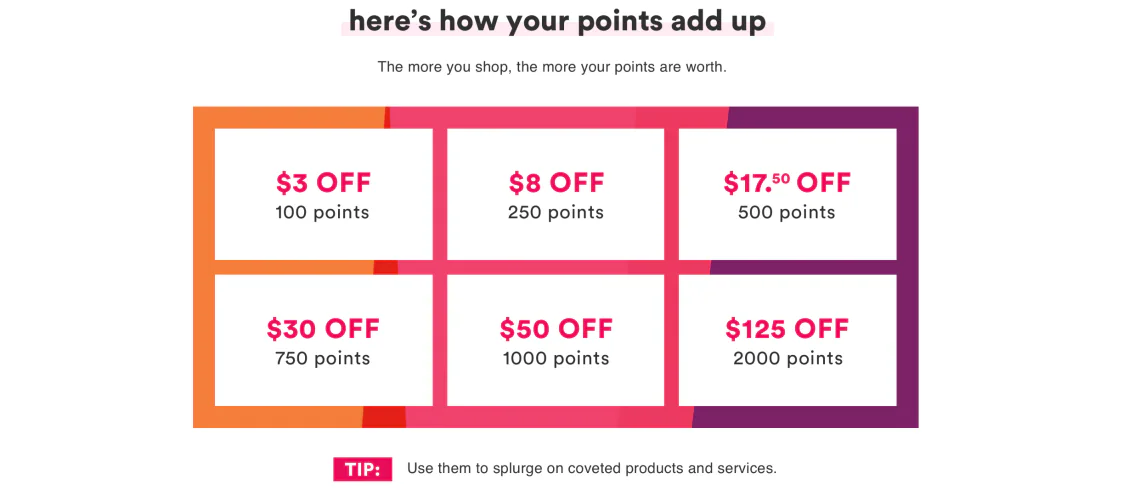
Examples of Ulta Beauty Rewards points and discount values. Image source: Glossy.
The value per point rises at higher redemption thresholds, subject to the program’s rules. That suits a category where customers replenish familiar items and can easily understand how accumulated points reduce a future purchase.
Ulta also offers birthday benefits and qualifying bonus-point promotions. The exact rules and exclusions are documented by Ulta Beauty Rewards and its official rewards FAQs.
For a smaller retailer, the lesson is clarity. Customers should be able to answer two questions: what do I earn, and what can I receive? A fixed discount after a defined spending threshold is easy to explain, provided the resulting reward remains affordable for the business.
3. e.l.f. Beauty Squad: Rewarding more than purchases
e.l.f. Beauty Squad recognizes activity beyond direct ecommerce transactions. Members earn 10 points for every eligible dollar and progress through Fan, Pro and Icon levels. Earning 1,000 qualifying points within a calendar year reaches Pro, while 2,000 points unlocks Icon status.
According to e.l.f.’s Beauty Squad documentation, supported engagement activities can also earn points. Eligible purchases from authorized retailers may count after receipt submission and verification—useful for a cosmetics brand whose customers often shop through third parties.
The model shows how reviews, games or other participation can contribute value as well as purchases. It also exposes an operational challenge: every rewarded action needs appropriate verification, limits and controls. A smaller brand should begin with behavior it can reliably identify, because unreliable engagement tracking creates more problems than a simple purchase reward.
4. LUSH Club Rewards: Extending loyalty beyond the transaction
LUSH Club Rewards shows how loyalty can reinforce an existing brand experience. In the US program, members earn one point for each whole dollar spent on eligible purchases and other qualifying transactions. Rewards unlock at published thresholds without deducting points from the member’s balance.
Current LUSH Club materials describe free gifts with purchase, event opportunities and early product access. Its discount guidance also references rewards such as 20% off or a $10 credit. Conditions, expiry dates and availability vary by reward and market.
The separate Bring It Back initiative rewards eligible packaging returns in supported markets. It is not the same as LUSH Club Rewards, but both illustrate brand alignment: product discovery supports the retail experience, while packaging returns connect with environmental priorities. A smaller brand should choose a benefit that reinforces something it already does well rather than copying an unrelated feature.
5. Glossier Membership: Building loyalty without traditional points
Glossier offers a contrast to conventional points programs. Its current Membership proposition focuses on access and recognition, including early access to launches and sales, gifts and other member benefits. Published information has also featured a welcome gift linked to a qualifying purchase, although specific promotions can change.
Unlike Ulta, Glossier does not present a comparable standard points-earning and redemption structure. For a brand with a recognizable identity, carefully chosen access or gifts may be more appropriate than routine discounts.
The current benefits and availability appear on Glossier’s official Membership page. The transferable idea is a simple membership proposition: early access, an occasional gift or first access to limited stock. It still needs clear eligibility and fulfillment processes, but it does not require a complicated points balance or multiple tiers.
What should smaller beauty brands copy—and what should they avoid?
The five brands illustrate several approaches, but copying their programs feature for feature would rarely make sense for a smaller business.
Large beauty retailers have substantial product ranges, marketing budgets, customer data and operational infrastructure.
A smaller brand needs rewards that its customers value and that its team can consistently deliver.
| Idea worth considering | Why it can work | What to watch out for |
|---|---|---|
| Clear points and discount thresholds | Customers understand what they earn | Rewards must fit product margins |
| Early access to selected products | Creates recognition without requiring an automatic discount | Access must offer genuine value |
| Product samples or discovery gifts | Encourages customers to try other products | Include inventory, packaging and fulfillment costs |
| Rewards for reviews or referrals | Recognizes customer advocacy | Attribution and verification require suitable systems |
| Simple membership benefits | Builds a recognizable customer relationship | Benefits still need consistent administration |
| Multiple loyalty tiers | Can recognize different spending patterns | Too many tiers may add complexity without improving the experience |
The most useful principle is to start with a behavior worth encouraging.
A skincare brand may want customers to replenish products regularly.
A cosmetics retailer may want customers to discover additional product categories.
A new beauty brand may value product reviews and returning customers more than membership status.
Those businesses may need different rewards even if they serve similar shoppers.
For most small businesses, simplicity is an advantage.
A customer who can understand their next reward immediately has less work to do than someone navigating an elaborate points system.
What would a realistic beauty rewards program look like?
Imagine an independent skincare retailer that wants to encourage customers to return for their next purchase.
It doesn’t need to introduce three membership tiers, exclusive events and an extensive rewards marketplace immediately.
A simpler model might be more practical.
Example: A straightforward skincare rewards program
The business introduces the following hypothetical rules:
- Membership is free.
- Customers earn one point for each dollar of qualifying spending.
- At 100 points, they unlock a $5 discount on a future eligible purchase.
- Customers can view their current points balance.
- Returned or refunded purchases are handled according to the program’s stated rules.
- The business offers an occasional sample or birthday benefit if its budget permits.
Consider a customer making two purchases.
Their first eligible purchase is $40.
They earn 40 points.
Their second eligible purchase is $60.
They earn another 60 points, reaching 100.
They can now redeem the $5 reward on a qualifying future purchase.
What would that reward cost?
At the stated earning rate, $100 of qualifying spending creates a $5 reward entitlement.
That represents a 5% headline reward rate.
It does not mean the business automatically loses 5% of revenue or that the loyalty program will increase profit.
Actual costs depend on:
- How many customers redeem their rewards.
- The business’s product margins.
- Whether rewards are combined with other discounts.
- Whether rewards require another purchase.
- Refunds and cancellations.
- Any technology or administration costs.
A business selling products with different margins may also need to exclude certain items or adjust its reward structure.
The goal is to create a reward that customers consider worthwhile without undermining the economics of the business.
What should the business measure?
Start with a few useful indicators:
Participation: How many eligible customers join?
Redemption: How many earned rewards are actually used?
Repeat purchasing: Do participating customers return, and how does their behavior compare with an appropriate baseline?
Reward cost: What is the real cost of fulfilled rewards?
These measures help the business assess the program.
They should not be confused with proof that the loyalty program caused every additional purchase.
Reliable purchase and revenue reporting requires appropriate transaction and customer records.
The business can add more sophisticated features after establishing that the initial model is manageable and useful.
For a broader explanation of program design and measurement, see our loyalty program strategy guide.
Where digital wallet loyalty cards fit into a beauty rewards program
After deciding how customers earn rewards, a beauty business needs a convenient way to identify members and show their benefits. A digital loyalty card can place a member identifier, points balance or tier in Apple Wallet or Google Wallet without requiring a dedicated brand app.
PassKit provides tools to create, issue, manage and update those cards. A retailer can give customers an enrollment link or QR code, identify them when they present the pass and update displayed information through an appropriate workflow.
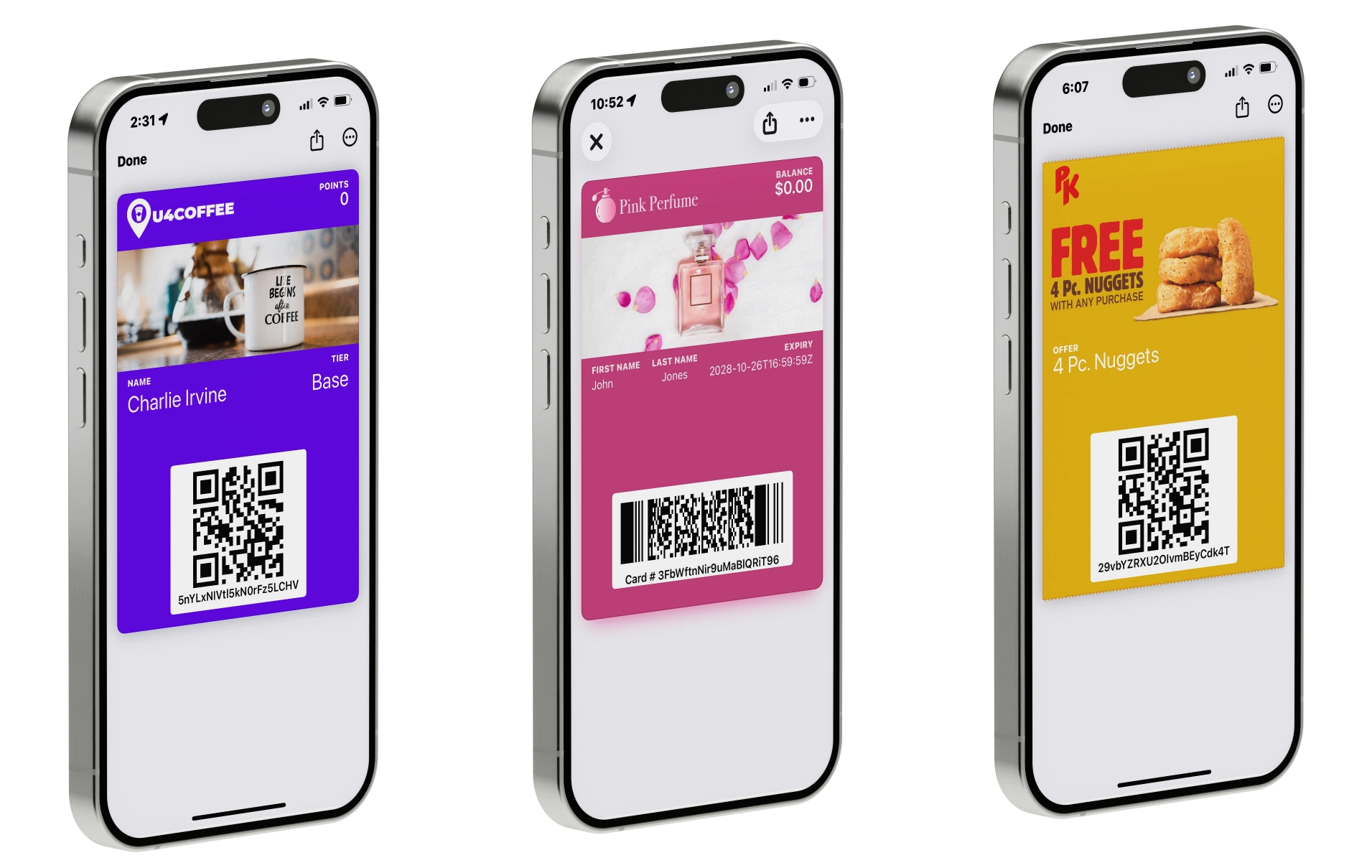
Example wallet designs for a coffee loyalty card, a beauty gift card and a promotional coupon.
Creating a digital loyalty card does not automatically connect it to every purchase made by the customer.
If the retailer uses a point-of-sale system to calculate points, the relevant transaction information must be passed through a suitable integration.
PassKit’s POS integration documentation explains how the commerce system can determine the reward and update the digital pass.
For businesses using a simpler operational model, authorized staff can also adjust supported points balances manually through PassReader.
The right approach depends on transaction volume and the systems the business already uses. PassKit provides the wallet credential and pass-management functionality; the business remains responsible for recording qualifying activity and applying its financial rules.
For a detailed setup walkthrough, see our guide to creating loyalty cards for Apple Wallet and Google Wallet.
Frequently asked questions about beauty loyalty programs
What are the best beauty loyalty program examples?
Sephora Beauty Insider, Ulta Beauty Rewards, e.l.f. Beauty Squad, LUSH Club Rewards and Glossier Membership illustrate several useful approaches.
Sephora combines points and status. Ulta emphasizes understandable purchase rewards. e.l.f. recognizes supported customer activities. LUSH connects rewards with product experiences. Glossier emphasizes membership benefits and access.
The best model for a particular business depends on its customers, margins and operational capabilities.
Which beauty loyalty program offers the best value for regular shoppers?
It depends on what the shopper values and how they buy.
Ulta provides particularly clear monetary redemption: its published schedule lists 500 points for $17.50 off. Sephora’s standard cash option offers $10 off for 500 points, but members can also choose changing product rewards and experiences through the Rewards Bazaar. The two figures are not a direct like-for-like comparison because earning rates, tier bonuses, eligibility and alternative rewards differ.
For customers who prefer access over discounts, Glossier’s early launches and gifts may feel more valuable. LUSH emphasizes threshold rewards and brand experiences, while e.l.f. recognizes eligible purchases and supported engagement across channels.
Regular shoppers should compare how quickly they would earn a useful reward, whether they want discounts or products, and any conditions attached to redemption. For a beauty business, the lesson is to define value around its own customers rather than copying the largest headline discount.
Are beauty rewards programs the same as store credit cards?
No.
A beauty loyalty program rewards eligible customer activity or membership.
A store credit card is a financial product with separate eligibility, repayment and account terms.
Some retailers may connect credit-card spending with loyalty benefits, but a business does not need to offer credit to operate a rewards program.
Should a small beauty business use points or membership tiers?
A straightforward points system is often easier to introduce when the goal is rewarding repeat purchases.
Membership tiers may be useful when the business has distinct groups of customers and can offer meaningful differences in benefits.
Adding tiers without worthwhile benefits can create unnecessary complexity.
Start with a clear goal and a reward structure the business can administer reliably.
Can customers use a beauty loyalty card without downloading a branded app?
Yes.
A business can provide compatible digital loyalty cards through Apple Wallet or Google Wallet instead of developing its own customer-facing mobile app.
Customers still need a compatible device and the relevant wallet functionality.
The business also needs a process for identifying members and applying rewards.
Can PassKit automatically award points after a purchase?
PassKit can display and update loyalty information, but purchase-based automation requires the relevant transaction data and configured workflow.
An integrated commerce or POS system can determine how many points a qualifying purchase earns and send the necessary update.
PassReader also supports manual adjustments for authorized staff.
Simply issuing a wallet card does not automatically establish purchase tracking or reward calculations.
What beauty brands can learn from these programs
Successful beauty loyalty programs don’t depend on one formula. For a smaller beauty business, the practical starting point is to identify the behavior worth encouraging, choose a reward customers value and confirm that the business can deliver it sustainably.
If digital wallet cards fit that model, PassKit can help you create branded Apple Wallet and Google Wallet loyalty cards without developing your own wallet infrastructure.
You can explore the platform through PassKit’s 45-day free trial.