
10 Customer Retention Examples From Real Brands
Explore 10 customer retention examples from Starbucks, Chewy, Duolingo, Spotify and more, with real tactics, reported results and lessons for your business.

Customer retention means keeping existing customers buying, subscribing or using a product over time. The best customer retention examples show what a business does to earn that next purchase, renewal, visit or interaction.
Some companies use rewards. Others simplify repeat purchases, help customers develop habits or make an existing relationship more valuable.
Starbucks encourages repeat visits through rewards and membership status. Chewy makes replenishing pet supplies easier with recurring deliveries. Duolingo gives learners a reason to return through daily streaks.
Each addresses a different reason customers might stop coming back.
This guide examines ten real-world customer retention examples, the mechanisms behind them and the ideas smaller businesses can realistically apply.
10 customer retention examples at a glance
| Company | Retention approach | What customers receive | Lesson for other businesses |
|---|---|---|---|
| Starbucks | Points and membership tiers | Redeemable Stars, personalized perks and status benefits | Make repeat visits rewarding |
| Chewy | Recurring orders | Scheduled deliveries and eligible Autoship savings | Remove friction from repeat purchases |
| Duolingo | Habit-building | Daily streaks and visible progress | Make returning easy enough to become a habit |
| Target | Personalized loyalty offers | Relevant deals and membership benefits | Reward customers according to their needs |
| Marriott | Tiered recognition | Points and hotel benefits linked to membership status | Recognize long-term customer value |
| Spotify | Personalized milestones | Annual listening recaps and shareable experiences | Celebrate customers’ history with your business |
| Panera Bread | Loyalty and subscriptions | Food rewards, membership benefits and a beverage subscription | Combine accessible rewards with optional recurring value |
| REI | Membership benefits | Rewards on eligible purchases and member-only offers | Provide value between infrequent purchases |
| Notion | Guided onboarding | Relevant starting templates | Help customers experience value sooner |
| Patagonia | Trade-in services | Credit for eligible used products | Extend the relationship after the sale |
The approaches vary because the businesses have different customer relationships.
A coffee shop may need to encourage frequent visits. A software company may need to help new users develop a habit. A retailer selling expensive products may need to stay relevant between purchases.
The strongest approach starts with the customer behavior a business actually wants to improve.
10 real-world customer retention examples
1. Starbucks Rewards: Making everyday purchases feel rewarding
A regular Starbucks customer might buy coffee several mornings a week. Starbucks Rewards gives that customer another reason to identify themselves and continue visiting.
In March 2026, Starbucks introduced a refreshed loyalty program with three membership levels: Green, Gold and Reserve.
Members collect Stars through qualifying activity and can redeem them for available rewards. The refreshed program introduced a 60-Star option worth $2 off an eligible purchase, alongside other benefits.
Higher membership levels provide additional recognition, including faster Star earning and selected exclusive perks.
The structure serves two groups.
Occasional customers can work toward an accessible reward. Frequent customers can see their progress toward a higher membership level.
Starbucks also uses personalized benefits and promotions to maintain engagement beyond individual purchases.
The company reported that Starbucks Rewards accounted for nearly 60% of revenue at US company-operated stores in fiscal 2025.
That illustrates the program’s importance to Starbucks’ customer relationships, although it does not establish how much additional revenue the program caused.
For an independent cafe, the useful lesson is simplicity.
Customers should understand what they earn, when they can redeem it and whether regular visits provide additional benefits.
A small business doesn’t need three membership tiers to achieve that. An attainable reward may be a better starting point.
Read more: Starbucks’ March 2026 Rewards announcement and its 2026 Investor Day update.
2. Chewy Autoship: Removing the effort from repeat purchases
Chewy illustrates a retention approach that doesn’t depend on collecting points.
Pet owners regularly need food, litter and other supplies. Buying those products repeatedly can become inconvenient, particularly when customers have to remember when they’re running low.
Chewy’s Autoship program allows customers to schedule deliveries of eligible products and adjust their delivery frequency.
Qualifying Autoship orders may also receive discounts.
The main benefit is convenience.
Instead of starting another purchase from scratch, customers can arrange to receive familiar products on a schedule that suits them.
This makes particular sense for products customers use continuously.
Chewy’s reported business figures show how significant these recurring customer relationships have become.
In its fiscal 2025 results, the company reported that 83.3% of net sales came from Autoship customers, compared with 79.2% in fiscal 2024.
Chewy defines these customers as people who received an Autoship order during the preceding 364 days. The sales figure includes their other purchases, not only automatically scheduled deliveries.
For businesses selling replenishable products, the underlying idea is highly transferable.
A skincare retailer could offer repeat ordering for frequently purchased moisturizers. A local pet shop might save customers’ usual orders. A supplier could simplify reordering commonly purchased items.
The important question is whether reducing the effort of another purchase helps customers return more consistently.
Sources: Chewy Autoship and Chewy’s fiscal 2025 financial results.
3. Duolingo: Using small achievements to build a lasting habit
Some of the strongest retention mechanisms have nothing to do with financial rewards.
Duolingo uses daily streaks to encourage learners to practice consistently.
A streak represents consecutive days of qualifying activity. Maintaining it gives learners a visible sense of progress and a reason to open the app again.
What’s particularly interesting is how Duolingo refined the feature.
The company discovered that users with demanding daily learning goals sometimes struggled to maintain their streaks, even when they were studying regularly.
Duolingo tested separating streak completion from the larger daily goal.
Under the change, a learner could extend their streak by completing just one lesson.
In its published experiment, Duolingo reported:
- A 3.3% relative increase in Day 14 retention.
- A 1% relative increase in daily active learners.
- A 10.5% relative increase in the proportion of daily learners maintaining a streak during the reported test period.
These are relative changes, not percentage-point increases.
This is one of the clearest examples in the article because Duolingo reported a test that directly measured retention.
The lesson is also more subtle than simply introducing gamification.
Duolingo improved engagement partly by making the habit easier to maintain.
A fitness app could recognize shorter workouts. An education platform might celebrate a completed lesson. A professional development service could encourage achievable weekly progress.
When the required action is manageable and meaningful, returning becomes easier.
Source: Duolingo’s published streak experiment.
4. Target Circle: Making loyalty offers relevant to the customer
Offering a discount isn’t necessarily enough to encourage another purchase.
The discount needs to be useful.
Target Circle illustrates how loyalty benefits can become more relevant when a retailer understands what customers already buy.
Target’s free membership program provides access to available deals, promotions and other member benefits.
In an October 2026 explanation of its pricing practices, Target described how shopping history can help identify offers customers may find relevant.
Someone who regularly purchases pet food might see a related promotion. Another customer who repeatedly buys household essentials may receive a useful offer or replenishment reminder.
Target also provides eligible members with benefits such as birthday discounts.
This approach creates a more personal reason to pay attention to the loyalty program.
Rather than repeatedly presenting every member with the same offer, the retailer can connect promotions with existing shopping interests.
Smaller businesses can apply the principle without sophisticated recommendation software.
A beauty retailer could distinguish skincare customers from fragrance buyers. A salon might send different promotions to customers booking haircuts and those booking color treatments.
The objective is to use information customers have appropriately shared to improve relevance.
Collecting more personal data isn’t automatically better. The value comes from delivering something useful in return.
Source: Target’s explanation of personalized Target Circle deals.
5. Marriott Bonvoy: Rewarding long-term customer relationships
Hospitality businesses often deal with irregular purchasing patterns.
A customer might stay at a hotel once this month and not travel again for several months.
Marriott Bonvoy addresses that challenge through a loyalty program that recognizes qualifying activity across participating properties.
Members can collect points and receive benefits according to program rules.
Marriott also offers multiple Elite membership levels, including Silver, Gold, Platinum, Titanium and Ambassador Elite.
Depending on the level, property and applicable conditions, benefits can include bonus points, late checkout and other privileges.
The important retention mechanism is continuity.
A traveler who has already earned a particular membership level may have a reason to consider Marriott when arranging the next trip.
The relationship carries forward beyond the most recent stay.
Unlike a simple discount, membership status can provide recognition that remains relevant across multiple visits.
This principle can be useful for businesses with less frequent transactions.
A salon could recognize regular customers after a defined number of appointments. A specialist retailer might give returning customers early access to selected products. A service provider could offer useful benefits after several completed bookings.
The higher level must provide something customers genuinely appreciate.
A premium-sounding membership label is not valuable without worthwhile benefits behind it.
Source: Marriott Bonvoy’s published membership benefits.
6. Spotify Wrapped: Turning customer history into an experience
Spotify Wrapped demonstrates how a company can use a customer’s accumulated activity to create a memorable experience.
Each year, Spotify gives eligible users a personalized overview of their listening.
Its 2025 Wrapped experience included information such as listening minutes, favorite artists and other individual highlights.
The appeal comes from the customer’s own history.
Two people using the same service can receive substantially different experiences because their listening habits are different.
Wrapped also creates a reason to revisit, discuss and share something customers have already enjoyed.
Spotify reported that its 2025 campaign generated more than 300 million engaged users and over 630 million social-media shares worldwide.
Those figures demonstrate engagement with the campaign rather than a directly measured reduction in churn.
The broader lesson is that retention communications don’t always need to promote another purchase.
Sometimes they can remind customers of the progress, experiences or value they’ve already gained.
A gym might celebrate completed workouts. An education provider could recognize courses finished. A subscription business could highlight a customer’s anniversary or meaningful achievements.
The strongest examples make customers feel that the recognition reflects their own experience rather than a generic marketing message.
Sources: Spotify’s 2025 Wrapped experience and Spotify’s fourth-quarter 2025 results.
7. Panera Bread: Combining loyalty rewards with recurring value
Panera provides an example of how a business can offer different benefits to occasional and frequent customers.
In August 2026, the company refreshed its MyPanera program with a points-based rewards structure.
Under the announced US program, eligible purchases earn 10 points per dollar. Members can redeem points for qualifying menu items, with options ranging from smaller bakery products to larger meals.
The refreshed program also introduced different membership levels.
MyPanera is free to join. MyPanera+ provides additional benefits for customers who meet the required annual spending threshold.
The MyPanera+ Sip Club adds a paid subscription option.
Under Panera’s published 2026 rules, that subscription includes up to 30 eligible beverages per redemption period and other available benefits.
It is not an unlimited-drinks entitlement.
The combination is interesting because Panera doesn’t require every customer to make the same commitment.
Occasional customers can use the standard loyalty program. Customers who visit more frequently may find value in the additional benefits or subscription.
A local cafe might consider a similar distinction.
Free rewards could encourage occasional customers to return. A recurring beverage offer might appeal to customers who already visit several times each week.
However, paid subscriptions introduce costs and obligations.
Before launching one, a business needs to understand whether customers visit frequently enough to value the benefit and whether actual redemption costs make the offer sustainable.
Sources: Panera’s August 2026 MyPanera announcement and Sip Club terms.
8. REI Co-op: Keeping customers connected between infrequent purchases
Not every retailer can expect customers to purchase something every week.
Outdoor equipment may last for years.
REI’s membership model demonstrates how a business can maintain an ongoing relationship even when customers buy relatively infrequently.
REI Co-op members can access benefits including rewards on eligible purchases and selected member-only offers.
The annual Co-op Member Reward gives customers an opportunity to revisit the value they’ve accumulated and consider their next purchase.
In March 2026, REI announced $200 million in annual Co-op Member Rewards.
Its published program information describes an estimated 10% reward on qualifying purchases, subject to exclusions and conditions.
The company also connects membership with seasonal offers, selected products and services related to outdoor activities.
This matters because the relationship extends beyond an individual transaction.
A customer may not need another tent immediately, but they can still have reasons to remain engaged with REI.
For businesses with longer purchasing cycles, a conventional frequent-purchase reward may not be appropriate.
A furniture retailer, specialist equipment supplier or outdoor shop might instead focus on useful product information, seasonal benefits, servicing or relevant new products.
The aim is to stay valuable between purchases without artificially encouraging customers to buy things they don’t need.
Source: REI’s March 2026 Member Month announcement.
9. Notion: Helping new customers reach their first useful result
Customer retention can be influenced before someone develops a regular habit.
This is particularly important for software products.
A customer might sign up with genuine interest, open the product and then leave because they don’t understand how to get started.
Notion addresses part of that challenge through its onboarding experience.
According to Notion’s documentation, new workspaces can include starter templates selected using information provided during onboarding.
Instead of leaving every new customer with an entirely empty workspace, Notion can provide a relevant example they can adapt.
For someone organizing projects, taking notes or managing tasks, an existing template can make the product easier to understand.
The retention opportunity is straightforward: customers are more likely to develop a useful routine if they experience the product’s value early.
Notion’s documentation establishes how the feature operates, although it does not publish a specific retention improvement attributable to these templates.
For another software business, the practical question is:
What is the first meaningful result a new customer should achieve?
It might be creating a project, importing contacts, publishing a page or completing a first transaction.
The onboarding experience should help customers reach that point with as little unnecessary friction as possible.
Source: Notion’s starter-template documentation.
10. Patagonia Worn Wear: Continuing the relationship after a sale
Patagonia illustrates a customer relationship that extends beyond buying new products.
Its Worn Wear initiative includes a US trade-in program for eligible used Patagonia clothing and equipment.
Customers can submit qualifying items through supported stores or a mail-in process.
Accepted products earn merchandise credit that can be used according to the program’s terms.
This creates another reason for a customer to interact with the business after their original purchase.
Instead of returning solely because of a sale or promotion, someone might come back to trade in an item they no longer need.
The credit can also contribute toward another eligible purchase.
The approach aligns with Patagonia’s broader emphasis on keeping products in use.
A smaller business may not have the resources to establish a comparable resale operation.
Trade-ins require product assessment, inventory handling and potentially significant logistical costs.
But the wider retention principle is useful.
A retailer could provide maintenance guidance, product-care information, repair services or support when customers are ready to replace something.
The relationship doesn’t have to end when the first purchase is completed.
Source: Patagonia’s official Worn Wear trade-in information.
Which customer retention strategy should your business use?
The examples above solve different problems.
A customer who forgets to reorder a product needs a different solution from someone who stops using software after the first day.
Start by identifying the behavior you want to improve.
| Business or challenge | Useful example | Practical first step | What to measure |
|---|---|---|---|
| Cafe or restaurant | Starbucks, Panera | Introduce an attainable repeat-visit reward | Repeat visits and redemption |
| Ecommerce store selling consumables | Chewy | Make regular products easier to reorder | Repeat purchase rate |
| Retailer serving different customer interests | Target | Send offers based on relevant purchase preferences | Subsequent purchases |
| Software with poor early engagement | Notion, Duolingo | Simplify activation or encourage a manageable habit | Activation and cohort retention |
| Business with infrequent purchases | REI, Patagonia | Provide a meaningful post-purchase benefit | Repeat customers over an appropriate period |
| Subscription business | Panera | Test a recurring benefit with clear value | Renewal, cancellation and benefit cost |
For example, an independent skincare retailer might notice that customers buy a particular moisturizer but don’t return when they’re likely to need another.
A timely reminder or simple repeat-purchase reward may address that problem.
For reward options you can adapt, see these practical loyalty program ideas.
A salon might already have loyal customers but struggle with inconsistent rebooking.
Making the next appointment easier could be more effective than adding points.
A software business might discover that people sign up but never complete the first meaningful action.
Improving onboarding would then be a more logical priority than introducing a referral program.
The useful approach depends on why customers leave, not on which famous company offers the most elaborate program.
Three mistakes worth avoiding
Introducing tiers without meaningful benefits. Higher levels only provide value when customers can see a worthwhile difference.
Rewarding activity that doesn’t support the business. Discounts, free products and other incentives have costs. They should encourage a useful customer behavior.
Adding complexity before measuring the basics. A straightforward program that customers understand may be more effective than one with multiple overlapping offers and complicated conditions.
For businesses planning a rewards program, our loyalty program strategy guide explains the wider design considerations.
How can you measure customer retention?
The most important question is not whether customers joined a program.
It is whether existing customers continued buying, renewing or using the product.
A loyalty program may have thousands of members without proving that those people return more often because of it.
Calculate customer retention rate
A straightforward customer-based calculation is:
Customer retention rate = (Starting customers still active at the end of the period ÷ Total starting customers) × 100
Imagine a business begins a measurement period with 200 customers.
At the end of that period, 150 of those original customers still meet its definition of active.
The retention rate is:
150 ÷ 200 × 100 = 75%
Customers newly acquired during the period are not counted as retained members of the starting group.
The definition of active should reflect the business.
For a subscription service, it might mean continuing to pay for a subscription.
For ecommerce, it could mean purchasing again within an appropriate timeframe.
For software, it might mean completing a meaningful activity during a specified period.
A retailer selling weekly essentials will need a different measurement window from a company selling products customers replace every few years.
Match the measurement to the strategy
| Retention approach | Useful measures |
|---|---|
| Loyalty rewards | Repeat purchase rate, redemption rate and reward cost |
| Recurring orders | Repeat-order frequency and continued participation |
| Subscriptions | Renewal rate, cancellation rate and subscription profitability |
| Software onboarding | Activation rate and Day 7, 14 or 30 cohort retention |
| Engagement campaigns | Returning users and sustained activity after the campaign |
| Post-purchase services | Repeat customers, service usage and later purchases |
Where possible, compare similar customer groups over the same period.
Customers who voluntarily join a loyalty program may already be more likely to return than those who don’t.
That makes a simple comparison between members and nonmembers potentially misleading.
Also measure the cost of delivering the retention initiative.
A program may increase participation while giving away more value than the business can sustainably afford.
The objective is to improve a valuable customer relationship, not simply increase the number of rewards distributed.
How digital wallet loyalty cards can support customer retention
Several of these examples rely on identifying returning customers and making their benefits easy to access.
For a physical business, a loyalty card can be one part of that experience.
Digital loyalty cards allow customers to keep compatible membership credentials in Apple Wallet or Google Wallet instead of carrying plastic cards.
Depending on the program, a digital card can display a membership identifier, points balance, tier or other useful information.
PassKit provides infrastructure for businesses to create, issue, manage and update these digital loyalty cards.
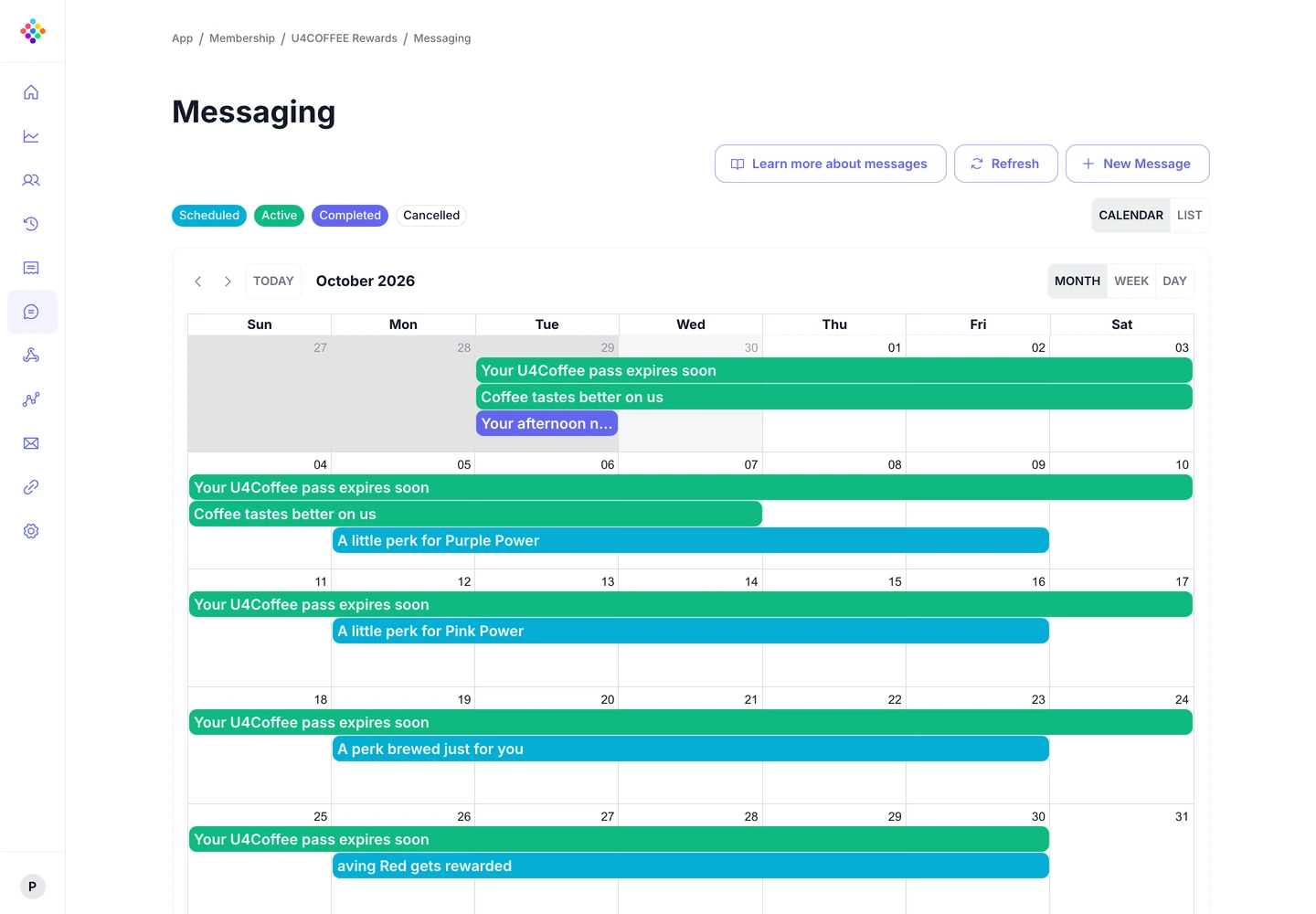
PassKit Messaging calendar showing scheduled communications for wallet pass holders.
For example, a retailer could:
- Create a branded loyalty card.
- Give customers a link or QR code to add it to their mobile wallet.
- Identify members when they present the card.
- Record qualifying activity through an appropriate workflow.
- Update the information displayed on the card.
The card makes the membership credential accessible.
However, installing a digital loyalty card does not automatically establish purchase tracking or calculate customer retention.
A wallet pass does not independently know when a customer has made a payment.
The business still needs a suitable method of recording qualifying purchases and applying its rewards rules.
This could involve an integration with existing commerce or point-of-sale systems. Authorized staff can also manage supported points through PassKit’s PassReader application.
PassKit’s reporting can help businesses understand digital pass distribution and lifecycle activity. Transaction-level customer retention and revenue analysis require the appropriate underlying business records.
For more information, see:
- PassKit digital loyalty cards.
- Integrating a POS system with PassKit.
- Managing loyalty points with PassReader.
Frequently asked questions about customer retention examples
What is a simple example of customer retention?
A coffee shop rewarding a customer after a defined number of eligible visits is a simple example.
The reward provides an incentive to return.
The business should measure repeat visits to determine whether the program actually changes customer behavior.
What are the main types of customer retention strategies?
Common approaches include loyalty rewards, recurring orders, subscriptions, personalized offers, onboarding improvements, habit-building and post-purchase services.
Starbucks illustrates purchase rewards, Chewy illustrates recurring orders and Duolingo illustrates habit-building.
Businesses can combine approaches when they address different customer needs.
What are the best customer retention examples for small businesses?
A cafe could use a simple repeat-visit reward. A skincare retailer might make replenishment easier. A salon could simplify rebooking. A local shop might offer meaningful membership benefits.
The best approach depends on purchasing frequency, customer needs, operational capacity and reward costs.
How is customer retention different from customer loyalty?
Customer retention measures whether existing customers continue buying or using a business over time.
Customer loyalty describes their preference for or commitment to that business.
A loyal customer may be more likely to return, but customers can also make repeat purchases because of convenience, product availability or other practical factors.
Do you need a loyalty program to retain customers?
No.
Recurring deliveries, useful onboarding, habit-building features and strong customer service can all support retention without a traditional points program.
Loyalty programs are one option among several.
How do you know whether a customer retention strategy is successful?
Define what counts as an active customer, choose an appropriate measurement period and track how many existing customers remain active.
Use supporting measures such as repeat purchases, renewal rates, cancellation rates and customer value.
Don’t treat enrollment, email opens or rewards redemption as direct substitutes for customer retention.
Can digital loyalty cards improve customer retention?
Digital loyalty cards can make it easier for customers to keep and access their membership information.
They can support rewards and recognition when connected to suitable business processes.
Whether they improve customer retention depends on the overall program and should be evaluated using actual customer activity.
What these customer retention examples teach us
The ten examples demonstrate that customer retention doesn’t depend on one universal formula.
Starbucks rewards repeat visits. Chewy simplifies replenishment. Duolingo encourages habits. Target makes offers relevant. Marriott and REI recognize established customers. Spotify celebrates customer history, while Patagonia extends the relationship beyond a purchase.
For a smaller business, the most useful starting point is to identify why existing customers might not return.
Then choose a practical way to address that problem and measure whether behavior improves.
If digital loyalty cards fit that approach, PassKit can help you create and manage Apple Wallet and Google Wallet loyalty cards without building your own wallet infrastructure.
You can explore the platform through PassKit’s 45-day free trial.