
8 Best Loyalty Program Apps for Small Businesses Compared
Compare 8 loyalty program apps for small businesses, including PassKit, Square and Loopy Loyalty. Explore pricing, features and the best fit for your business.

The best loyalty apps for small business are not interchangeable. Some add rewards to a point-of-sale or ecommerce platform, while others use digital stamp cards, branded apps or Apple and Google Wallet passes.
That difference affects how customers join, how employees award rewards and what the business must integrate. A low monthly price is not good value if the app does not fit the way you sell.
We compared eight business loyalty platforms on their customer experience, reward options, integrations, pricing and operational fit. This guide focuses on software a small business can use to run its own rewards program, rather than consumer cashback or card-organizer apps.
Best loyalty apps for small businesses at a glance
| Loyalty app | Best for | Customer experience | Published starting price* | Main limitation |
|---|---|---|---|---|
| PassKit | Apple and Google Wallet loyalty cards | Customers save a pass to their phone wallet | From $39.50 per month | Purchase automation requires a POS, ecommerce or other data integration |
| Square Loyalty | Businesses already using Square | Customers enroll by phone number and earn at checkout | Included with Square Plus from $49 per location per month in the US | Best value is within the Square ecosystem |
| Loopy Loyalty | Simple digital stamp cards | Customers save a stamp card to Apple or Google Wallet | From $25 per month | Less suitable for complex points and ecommerce programs |
| Smile.io | Small Shopify stores | Rewards appear in the online storefront and customer account | Free for up to 200 monthly orders; paid plans from $15 per month | Primarily designed for ecommerce, especially Shopify |
| LoyaltyLion | Growing Shopify brands | Customers use an onsite loyalty page, panel or account | Free Shopify plan; Classic from $199 per month | Advanced features become expensive for a small store |
| Stamp Me | App-based digital punch cards | Customers normally join and view rewards in the Stamp Me app | From $49 per month in the US | The standard self-service journey asks customers to install an app |
| Loyverse | Retailers and cafes wanting free POS loyalty | Registered customers earn and redeem through Loyverse POS | Core POS and loyalty program are free | Reward rules are basic and tied to Loyverse POS |
| TapMango | Multi-location businesses wanting loyalty and marketing | Branded app, in-store enrollment and integrated rewards | Custom quote | More platform and sales process than many very small businesses need |
US pricing as of November 2026. Taxes, payment processing, hardware, messaging, implementation and usage-based charges may be additional.
Loyalty app comparison criteria
The comparison covers customer enrollment, reward options, checkout workflows, POS and ecommerce integrations, pricing, free-plan limits and suitability for small teams.
1. PassKit: best for Apple and Google Wallet loyalty cards
PassKit lets a business create, distribute and update branded loyalty passes for Apple Wallet and Google Wallet. A customer opens a link or scans a QR code, enters any required information and saves the pass to the wallet already on their phone. There is no separate customer loyalty app to install.
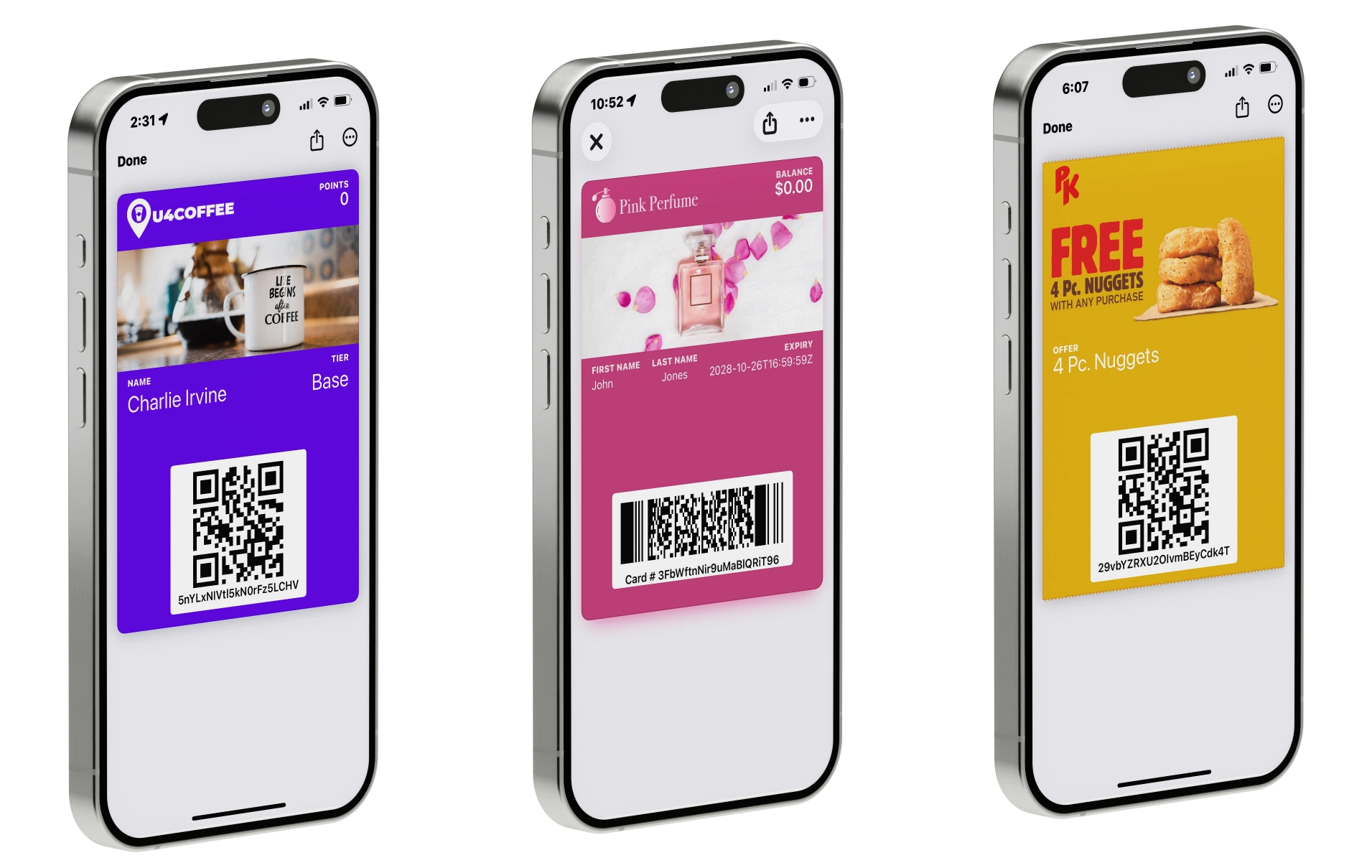
Passes can show a membership ID, balance, tier, barcode and offers. Businesses distribute them through channels such as email, SMS, websites and QR codes, then issue and update them through PassKit’s dashboard, APIs and webhooks.
The operational distinction matters: PassKit presents and distributes the digital credential, but it does not automatically detect every purchase or replace the business’s source-of-truth transaction and points ledger. Automatic earning and balance updates depend on a configured POS, ecommerce, CRM or other integration. For simpler in-person workflows, the PassReader app can scan passes and support points management when it has been configured for that program.
Advantages
- Familiar Apple Wallet and Google Wallet experience with no dedicated customer app.
- Real-time pass updates, push messages and location-relevant notifications.
- Flexible APIs and webhooks for custom workflows.
Limitations
- Businesses still need a reliable system or workflow to calculate qualifying purchases and rewards.
- It is not a complete POS system or a full ecommerce rewards engine by itself.
PassKit’s published pricing starts with a $39.50 monthly platform fee and included pass allowances; active pass volume, team members and other usage can affect the bill. A 45-day trial is available. PassKit is a strong fit when mobile-wallet access and flexible integration matter more than having a bundled POS.
Start a 45-day PassKit trial to test the customer and staff workflow with your own loyalty card.
2. Square Loyalty: best for businesses already using Square
Square Loyalty adds rewards directly to the Square checkout ecosystem. Businesses can configure earning by amount spent, visit, item or category, then offer one or more reward tiers. Customers generally enroll and identify themselves with a phone number at checkout, on an invoice or during an online order.
For a Square merchant, purchases, customer records, points and redemptions can flow through the system employees already use. Staff can look up members by name or phone number when redeeming a reward.
Advantages
- Loyalty is connected to the Square POS and eligible Square online transactions.
- Flexible points and reward rules for common retail and hospitality programs.
- Useful choice for a business already committed to Square payments and hardware.
Limitations
- The convenience declines if the business uses a different POS or payment stack.
- Subscription, payment processing, hardware and other Square services can all affect total cost.
Under Square’s current US plans, Loyalty is included with Square Plus, which starts at $49 per location per month, and higher plans. Processing fees and optional hardware are separate. Square is the most logical option here for an existing Square seller that wants rewards embedded in checkout rather than another standalone tool.
3. Loopy Loyalty: best for simple digital stamp cards
Loopy Loyalty specializes in digital stamp cards for Apple Wallet and Google Wallet. Customers receive a card through a link or QR code and save it to their wallet without creating a Loopy Loyalty account. Staff use the Loopy Loyalty Stamper app to scan the card, add stamps and redeem rewards.
That narrow focus suits visit-based businesses replacing paper punch cards. Merchants can update card content and send messages, while customers keep the card alongside their payment passes and tickets.
Advantages
- No dedicated customer app or plastic card required.
- Unlimited customers and cards under the published plans.
- Quick to understand for programs such as “buy nine, get the tenth free.”
Limitations
- Standard operation relies on staff scanning rather than automatic POS-based earning.
- Stamp programs offer less flexibility than advanced points, tier and referral engines.
Loopy Loyalty’s published plans start at $25 per month or $250 per year and include a 15-day trial. Higher plans add more card designs, locations and subusers. It is the clearest fit when a small business wants a straightforward digital replacement for a paper stamp card.
4. Smile.io: best for small Shopify stores
Smile.io is an ecommerce loyalty platform centered on points, referrals and, on higher plans, VIP programs. Merchants add a loyalty panel or page to their storefront, and customers use their store account to see ways to earn, check their balance and redeem rewards.
Its free plan includes points and referrals, while paid tiers add a loyalty page, integrations, more reward types and greater order allowances. Shopify POS support is available, but businesses using another POS should confirm compatibility.
Advantages
- Ecommerce-focused setup and customer experience.
- Free entry plan for stores with modest order volume.
- Points, referral rewards and common discount incentives.
Limitations
- The strongest fit is Shopify rather than an independent in-store program.
- VIP tiers, checkout redemption and some lifecycle controls sit on more expensive plans.
Smile’s public pricing starts with a free plan for up to 200 monthly orders. Essential starts at $15 per month, with higher tiers adding features and order capacity. Smile is a practical starting point for a Shopify store that wants visible onsite rewards without buying an enterprise platform.
5. LoyaltyLion: best for growing Shopify brands
LoyaltyLion combines points, rewards and customer engagement tools for ecommerce brands. Customers interact through the merchant’s storefront, loyalty page or account experience. Paid plans can add richer branding, integrations, analytics and VIP capabilities.
Its free Shopify plan covers a small set of earning activities and one money-off reward. Paid plans suit a growing brand that wants loyalty data connected to its email, review and ecommerce tools, but the price jump is material.
Advantages
- Designed around ecommerce retention and storefront engagement.
- Free Shopify option for a simple account-and-purchase points program.
- More room to develop a branded, segmented program as the store grows.
Limitations
- Referrals, reviews, birthdays, advanced integrations and VIP features may require an add-on or higher plan.
- Paid pricing may be difficult to justify for a low-volume store.
LoyaltyLion says its free plan is intended for Shopify stores with roughly 400 or fewer monthly orders, although that recommendation is not an enforced order limit. Its Classic plan starts at $199 per month and includes 500 monthly orders. LoyaltyLion suits a growing Shopify brand with a clear retention strategy and budget for deeper ecommerce features.
6. Stamp Me: best for app-based digital punch cards
Stamp Me turns punch-card loyalty into a mobile-app experience. A typical customer downloads the Stamp Me app, joins a merchant’s stamp card and presents the app when earning or redeeming rewards. Merchants manage the program through an online loyalty portal.
Eligible plans add messaging, birthday rewards and promotions. A merchant can create and manage a member without an app, but customers need it for the full self-service experience, including viewing stamps and vouchers.
Advantages
- Familiar punch-card model with a structured merchant portal.
- Does not require a complex POS integration for the standard workflow.
- Merchant-assisted participation is possible for customers without the app.
Limitations
- The normal customer journey adds an app download.
- Manual or separate stamping can add a step for employees.
Stamp Me’s US pricing starts at $49 per month for one location, with a 30-day trial. It works best for a local business that wants a dedicated-app punch card and will actively use the accompanying engagement features.
7. Loyverse: best free POS loyalty option
Loyverse includes a basic loyalty program in its free point-of-sale software. A business sets a percentage-based earning rate, registers customers and adds the relevant customer to each sale. Points are then awarded through Loyverse POS and can be redeemed as a discount at checkout.
Customers see their balance on printed or emailed receipts. Staff find registered members in the POS and view their available points. It is a low-cost setup for a cafe or retailer willing to use Loyverse at checkout.
Advantages
- Core POS and loyalty program are free.
- Points earning and redemption are built into the sales workflow.
- Paid employee, inventory and extended-reporting tools are optional.
Limitations
- Reward logic is much simpler than dedicated loyalty platforms.
- Businesses must use Loyverse POS to obtain the integrated experience.
Loyverse’s pricing page lists the POS, loyalty program and several operational tools as free. Optional features such as Employee Management and Advanced Inventory are charged per store. Loyverse offers the strongest free proposition in this comparison when changing or adopting the POS is acceptable.
8. TapMango: best for multi-location loyalty and marketing
TapMango is a broader customer engagement platform offering points, punch cards, tiers, referrals, paid memberships, messaging and reputation tools. It also promotes branded mobile apps, online ordering and integrations with supported POS systems.
This breadth suits established businesses that want loyalty to work across locations and marketing channels. The tradeoff is a more involved buying and implementation process than an entry-level app.
Advantages
- Wide choice of loyalty structures and customer engagement tools.
- POS integrations and automatic earning can reduce manual work when the business’s system is supported.
- Suitable for businesses planning coordinated campaigns across locations.
Limitations
- Public fixed pricing is not provided; businesses must request a quote.
- The platform may be more than a single-location microbusiness needs.
TapMango states that pricing depends on locations, setup and required features. Before signing, ask for an itemized quote covering implementation, POS integration, devices, messaging, app services, support and any term commitment. TapMango is best shortlisted by businesses that need an integrated loyalty-and-marketing platform and are prepared for a sales-assisted rollout.
Which loyalty app is best for your business type?
Follow the sales workflow rather than the longest feature list.
- Cafe or salon replacing paper punch cards: Choose Loopy Loyalty for Apple or Google Wallet, or Stamp Me for a dedicated app and promotions.
- Retailer or cafe choosing a POS: Compare free Loyverse loyalty with Square’s more developed paid features, including payment, hardware and inventory costs.
- Existing Square merchant: Square Loyalty creates the least checkout friction.
- Shopify store: Smile.io is the accessible entry point; LoyaltyLion offers deeper retention tools at a higher price. See our guide to ecommerce loyalty programs.
- Wallet-native membership: Consider PassKit when wallet delivery is central and another system or workflow can supply purchase and balance data.
- Multi-location brand: Demonstrate TapMango when POS integration, messaging and referrals need to work together.
Free vs paid loyalty apps
A free app can be enough when its platform and limits fit the business. Loyverse includes loyalty in its POS, while Smile.io and LoyaltyLion offer limited free plans for smaller Shopify merchants.
Paid tools may add a different customer experience, integrations, messaging or advanced rewards. Compare the complete first-year cost, including:
- subscription and overage charges;
- payment processing and required ecommerce or POS plans;
- hardware, scanners or customer-facing devices;
- SMS, email or push-notification allowances;
- implementation and integration work;
- staff training, administration and reward costs.
A free plan that forces an unsuitable checkout migration may cost more than a paid tool that fits the current operation.
Loyalty app buying checklist
Evaluate vendors with a real earning-and-redemption scenario. A polished dashboard matters less than whether a customer and a new employee can complete it reliably.
- Define the goal. Choose visit frequency, order value, referrals, subscriptions or customer identification.
- Choose the reward logic. Stamps suit repeatable purchases, points suit varied baskets and tiers recognize longer-term value. Our loyalty card templates can help.
- Map customer identification. Confirm whether members use a phone number, account login, barcode, QR code, wallet pass, plastic card or app.
- Test every checkout route. Include refunds, exchanges, partial redemptions, offline sales and third-party orders.
- Identify the source of truth. Establish which system owns the customer record, transaction history, points balance and reward status.
- Check integrations in writing. Ask what data moves in each direction, how quickly and at what cost.
- Review privacy and consent. Collect only necessary data and define access, retention and deletion procedures.
- Model the total cost. Include locations, orders, active members, messages, users, passes, devices, support and implementation.
- Plan staff procedures. Document enrollment, earning, redemption, refunds, fraud and outages.
- Run a pilot. Measure enrollment, participation, redemption and incremental behavior before expanding.
If you need a wider market view, compare the product categories in our guide to loyalty platform providers.
Verdict: the best loyalty app depends on the operating model
There is no universal winner because these products solve different versions of loyalty.
- PassKit is the best fit for wallet-native loyalty cards and flexible integrations.
- Square Loyalty is the natural choice for a business already operating on Square.
- Loopy Loyalty is the simplest wallet-based replacement for paper stamp cards.
- Smile.io is the most accessible option for a small Shopify store.
- LoyaltyLion suits a growing Shopify brand investing more heavily in retention.
- Stamp Me fits businesses that prefer a dedicated-app punch-card experience.
- Loyverse provides the strongest free POS-and-loyalty combination.
- TapMango serves more established or multi-location businesses wanting loyalty and marketing in one rollout.
Shortlist the two products that match your current checkout and desired customer experience. Then ask each vendor to demonstrate the same join, earn, refund and redeem scenarios using your actual systems.
If a no-download Apple and Google Wallet experience is your priority, try PassKit free for 45 days before committing to a rollout.
Frequently asked questions about loyalty program apps
What is a loyalty program app?
It is software for enrolling members, applying earning rules and redeeming rewards. Customers may use an app, ecommerce account, phone number, wallet pass or scannable card.
How much does a small-business loyalty app cost?
Options range from free plans to custom-priced platforms. Include POS or ecommerce subscriptions, processing, hardware, messages, integrations and rewards when comparing total cost.
Are free loyalty apps good enough for a small business?
Yes, if the platform, order limits and reward rules fit. Loyverse suits POS users; free Smile.io and LoyaltyLion plans may suit small Shopify stores.
Do customers need to download an app?
Not always. Wallet passes, phone-number lookup and storefront accounts avoid a dedicated download. Stamp Me normally uses its app, while TapMango can provide a branded app.
Can a loyalty app connect to my POS?
Many can, but connection depth varies. Confirm the exact POS version, data exchanged, fees and behavior during refunds or outages.
Is a mobile wallet pass the same as a dedicated loyalty app?
No. A wallet pass displays loyalty information in Apple or Google Wallet. A dedicated app can offer a broader branded interface but requires another download.
Which rewards should a small business offer?
Choose a reward customers understand and the business can fund. Use stamps for similar purchases, points for varied values, tiers for recognition and referrals for acquisition.
What customer data does a loyalty program need?
Only collect data needed to identify and serve members, obtain the required consent, and define retention and deletion procedures for each market.
Can I switch loyalty platforms later?
Usually. Before buying, confirm that member identifiers, balances, reward status and consent records are exportable, and review contract and API terms.
Which loyalty metrics should I track?
Track enrollment, active members, earning, redemption, reward cost and purchase behavior. Compare results with a suitable baseline or control group to estimate incremental impact.