
Beyond the Pass: Apple Wallet and Google Wallet Best Practices
A practical mobile wallet strategy for making Apple Wallet and Google Wallet passes useful before, during and after every customer interaction.

For years, the first business case for a Wallet pass was straightforward: replace the thing a customer used to carry. A plastic loyalty card, a printed ticket, a membership card or a coupon could become easier to keep and easier to present on a phone.
That is still a good reason to begin. But it is not where the value ends. Once a business has placed something genuinely useful in Apple Wallet or Google Wallet, it has the opportunity to make the wider customer relationship easier too: before a visit, at the moment of interaction and when the customer is deciding what to do next.
This article is the strategic companion to our practical Wallet best-practices guide. That guide helps teams put a programme into practice. Here, the question is broader: how do you make a pass earn its place in a customer’s Wallet over time?
Digitisation is the starting point, not the outcome
There is no need to apologise for a practical first project. A retailer may want to make its loyalty scheme easier to use. A venue may want to remove friction from ticket entry. A membership organisation may need a more reliable way to show current entitlement. Those are useful, measurable problems.
The mistake is to define success as issuing the pass. A pass can be beautifully designed, successfully delivered and still become a static copy of what was previously plastic. The stronger question is: what job will it do for the customer after it has been saved?
That answer will differ by programme. A loyalty pass may make rewards and recognition easier to find. A membership pass can bring status and benefits closer to the moment they are needed. An event ticket can help a guest from planning through arrival and, where appropriate, after the event. Offers, gift cards and access credentials can each be a useful thread in an ongoing relationship rather than a one-time container for a code.
Thinking this way changes the brief. Instead of asking only, “How do we get a card into Wallet?”, a team can ask, “What should this customer be able to do more easily now?” That puts customer value ahead of the format.
A Wallet pass earns its place when it makes something genuinely easier for the customer, not simply when it has been issued.
Design the whole journey, not just the pass
Customers do not experience the organisational chart. They experience one journey. Before they arrive, they may need confirmation, a ticket, a balance, a member benefit or simple reassurance that they are ready. During the interaction, they expect recognition, entry, redemption or access to work without a hunt through email or another login. Afterwards, they may need a receipt, a new balance, the next useful action or a reason to return.
The pass can support all three stages, but only if the journey is designed deliberately.
- Before: help the customer prepare. Make the pass easy to add at a meaningful point, then keep essential details current: an event time, a membership status, a reward or a location-specific reminder where the customer has enabled the relevant settings.
- During: reduce the number of decisions at the point of use. A clear barcode, QR code or contactless interaction should serve a real operational process, not add another step for staff or customers.
- After: make the next moment useful. That could mean an updated balance, a benefit that is now available, practical follow-up information or a simple route back to the programme.
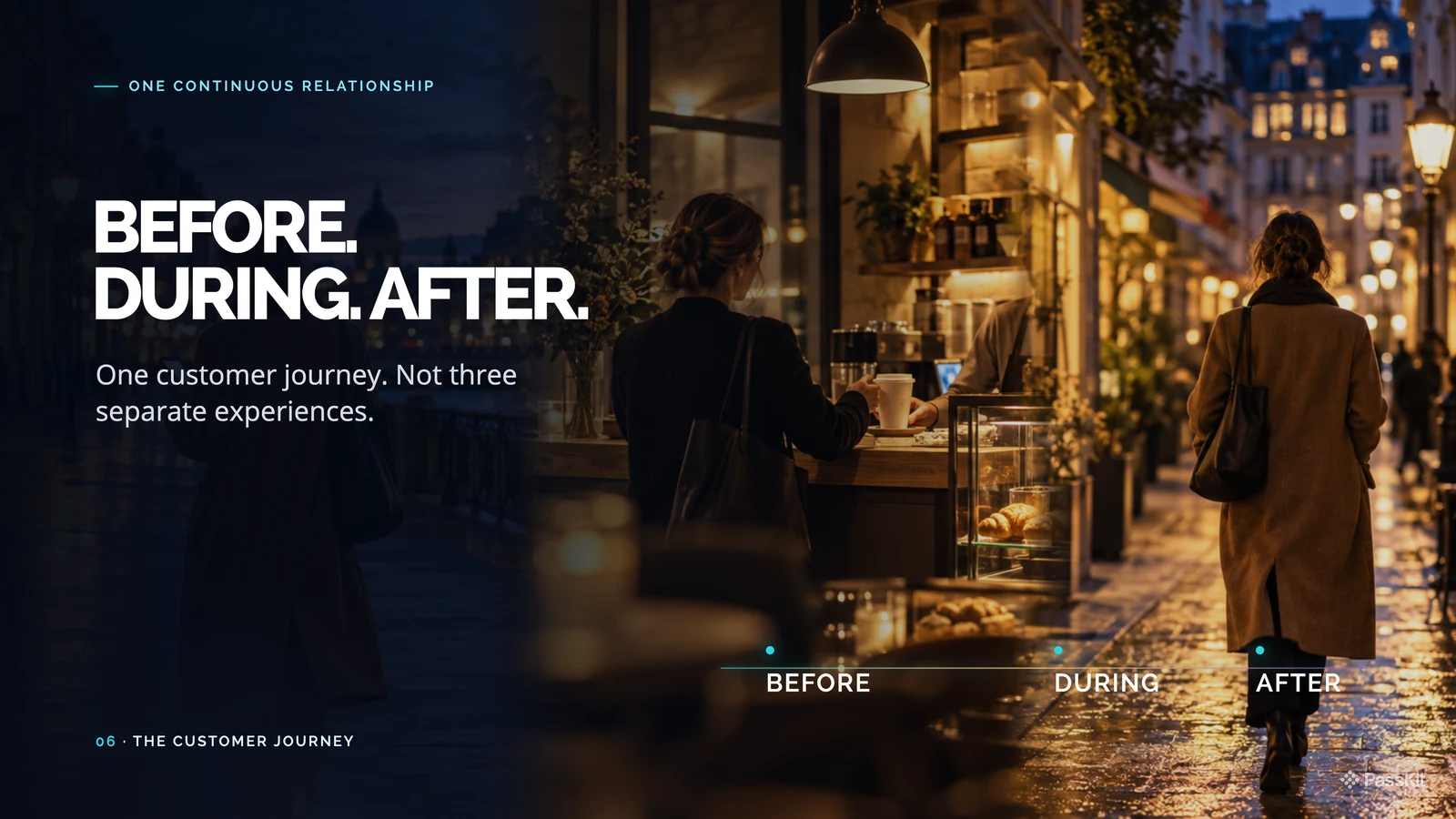
A Wallet pass can support one customer journey before, during and after the moment of use.
The most useful journeys are often modest. A coffee shop does not need to turn a loyalty interaction into a campaign. It may simply need rewards to be visible and redemption to be quick. An airline or venue has more moving parts, but the same principle applies: remove uncertainty at the moment the customer needs an answer.
Connect the people and systems behind the experience
A Wallet programme can expose a familiar business problem: the customer sees one brand while their information lives in several places. Loyalty, CRM, ticketing, point of sale, operations, marketing and customer support may each own a piece of the truth.
Technology can connect those systems, but the integration alone does not create a coherent experience. Teams need to agree which system is authoritative for a balance, status or entitlement; what happens when a record changes; and who owns the messages that reach a customer. They also need to test the awkward but important cases: a cancelled booking, a lost phone, a changed barcode, an expired offer or a busy venue with unreliable connectivity.
This is where an issuer-managed pass is meaningfully different from a static image or copied code. It can be part of an operating model that keeps the credential aligned with the underlying customer record. PassKit’s pass updates capability is designed for that continuing lifecycle, while pass redemption helps teams connect the moment of use to their own validation rules.
The goal is not to centralise every system. It is to make the hand-offs invisible to the customer. If a benefit changes, the customer should not have to discover it by accident. If an entitlement is no longer valid, the business should not rely on an old representation at the door or till.
Communicate for usefulness, not for volume
An active pass creates a tempting new channel. It is easy to see an update or notification as another promotional surface. That is precisely why discipline matters.
Customers are more likely to keep a pass when it consistently saves them time, clarifies something important or delivers value they expected. A changed event detail, an available reward, a balance update or a benefit relevant to an upcoming visit can be helpful. Repeated messages with no clear customer benefit become background noise, regardless of how technically sophisticated the programme is.
Start with a simple editorial test: would the customer be glad to receive this now? If the answer is unclear, the message probably needs more relevance, better timing or a different channel. A messaging plan should therefore be owned alongside the customer journey, with clear rules for frequency, audience, consent and measurement.
The measurement should move beyond pass issuance. Saves and downloads are useful early signals, but they do not tell you whether the programme is helping people. Look for the behaviours that matter to the business and customer: first use, successful redemption, repeat visits, benefit discovery, fewer support queries or smoother entry. Those measures reveal whether a pass is becoming useful rather than merely present.
The best Wallet communications save time, clarify something important or deliver value at the moment it matters.
Make the interaction effortless and dependable
The most visible moment in a Wallet programme is often the least forgiving. A queue is moving. A customer is arriving at a gate. A member is trying to access a service. This is not the place for uncertainty.
Choose the interaction method around the environment and the system that has to accept it. A barcode or QR code may be the right answer when existing scanners already support it. NFC can be a strong option when the device, terminal and programme have been configured for it. On Google Wallet and Apple Wallet, Smart Tap and Apple VAS are specific NFC redemption paths that depend on compatible terminals and issuer and merchant configuration; they do not make every pass contactless automatically.
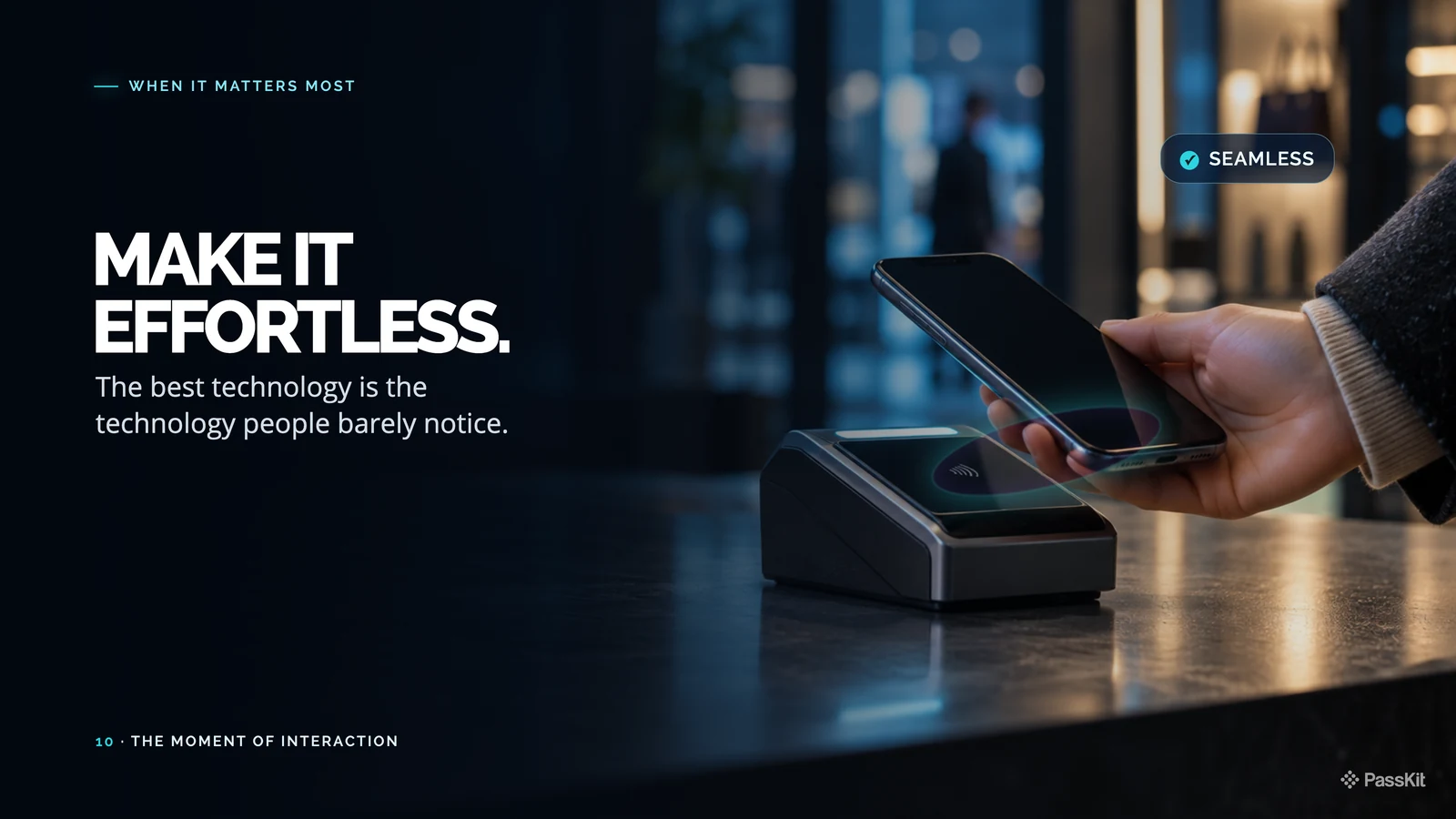
The interaction should feel effortless, whatever method the programme uses.
Whatever the method, test the real conditions: different devices, low screen brightness, staff handover, peak demand, interrupted connectivity and a sensible fallback. A customer should not need to understand the underlying technology. They should only notice that the interaction was quick and reliable.
Prepare for a more contextual future
Getting a brand into a customer’s Wallet is more than replacing a card. It creates a durable, permissioned presence when customers need to identify themselves, redeem a benefit or decide what to do next. The pass can carry their relationship and current benefits beyond a website visit, email campaign or single transaction.
Google Wallet offers a clear indication of how that context can travel. With its Use Wallet to personalise other Google experiences setting enabled, Wallet and payments data, including passes, can personalise other Google services. Examples include Play or YouTube recommendations or deals based on loyalty cards, and Google Shopping ads that may be based on passes or loyalty cards. The controls are rolling out gradually and remain entirely under the customer’s control. Read Google’s Wallet data and privacy guidance.
For a business, this makes a Wallet programme an important input to a broader SEO and discovery strategy. It is not an organic-ranking shortcut. But discoverability increasingly depends on relevance at the moment of choice, not only pages and keywords. A customer-held pass gives the business an opt-in relationship, current benefits and eligibility context that can make suggestions, offers and buying journeys more relevant as search becomes more personalised and AI-assisted.
The strategic opportunity: Businesses that put useful, active Wallet passes in customers’ hands today will be better placed to be relevant in the personalised search, discovery and buying experiences in the future.
The pass is only the beginning
The strongest Wallet programmes do not treat a pass as a digital substitute for plastic. They treat it as a compact, useful part of a larger customer experience.
Begin with the practical problem: make a ticket easier to use, make a loyalty benefit clearer, make a membership easier to recognise. Then design what happens before, during and after that interaction. Connect the teams and systems that need to cooperate. Communicate only when there is genuine value to deliver. And make the moment of use dependable enough that customers never have to think about it.
Do that well, and the pass becomes more than a credential on a phone. It becomes a direct, evolving connection that helps customers get value from the relationship they already chose to have. The pass is not the end product. It is only the beginning.